Table of Contents
Are flashcards effective for language learning? (Yes, they are!)
I sometimes see people say that flashcards are good for absolute beginners to build a foundation, but advanced learners should switch to learning vocabulary only by other methods like comprehensible input. While it’s true that flashcards can be a great tool for beginners to quickly learn the most frequent words in a language, some studies suggest that even advanced learners can benefit from language learning flashcards.
This systematic review of 32 studies found that independent (B1 or B2) and proficient (C1 or C2) learners may learn more words faster from flashcards than basic (A1 or A2) learners do. This may be because experienced learners have a better understanding of how to use flashcards properly to test themselves and use them more outside of class, or it could be because being at a higher proficiency level makes it easier to recall new words.
Whatever the case, it seems clear that language learning flashcards can be useful tools for memorizing new vocabulary and should not be written off as only for building foundational vocabulary! Now that I think about it, that’s just common sense. As a native English speaker, I used flashcards to study for advanced SAT vocabulary in high school. I certainly benefited from that even as a fluent speaker! If flashcards work for you, you should use them!
Tips for how to use flashcards for language learning
Don’t just make flashcards for words; make flashcards for phrases or sentences
One of the easiest ways to start making better flashcards or selecting better premade decks is to include cards with example sentences or phrases instead of only testing a single word. Here’s why:
- Having an example sentence helps you understand how a word is used in context. Knowing what a word means is no good by itself if you don’t know how to use it in a sentence. For example, simple term-definition flashcards don’t give you an idea of what prepositions are commonly paired with a word, or situations where you may use the word.
- Practicing common, everyday phrases and idioms, such as the Spanish phrase, pasar el rato (to pass the time/hang out), helps you commit the phrase to memory and makes it easier to recall the whole thing in conversation. That way, you don’t have to stop and think about what pasar means or how to string the phrase together; you just say it!
Try using flashcards to practice conjugation and grammar
One study method that I use almost every day is using flashcards to practice conjugation, grammar, and vocab at the same time. According to this study, full-sentence flashcards yield high gains in learning grammar rules. Exposure to proper sentence structures helps you internalize correct grammar, and self-testing to see if you can correctly compose a sentence with the right word order or verb conjugation can be a powerful tool for getting feedback and improving your accuracy over time.
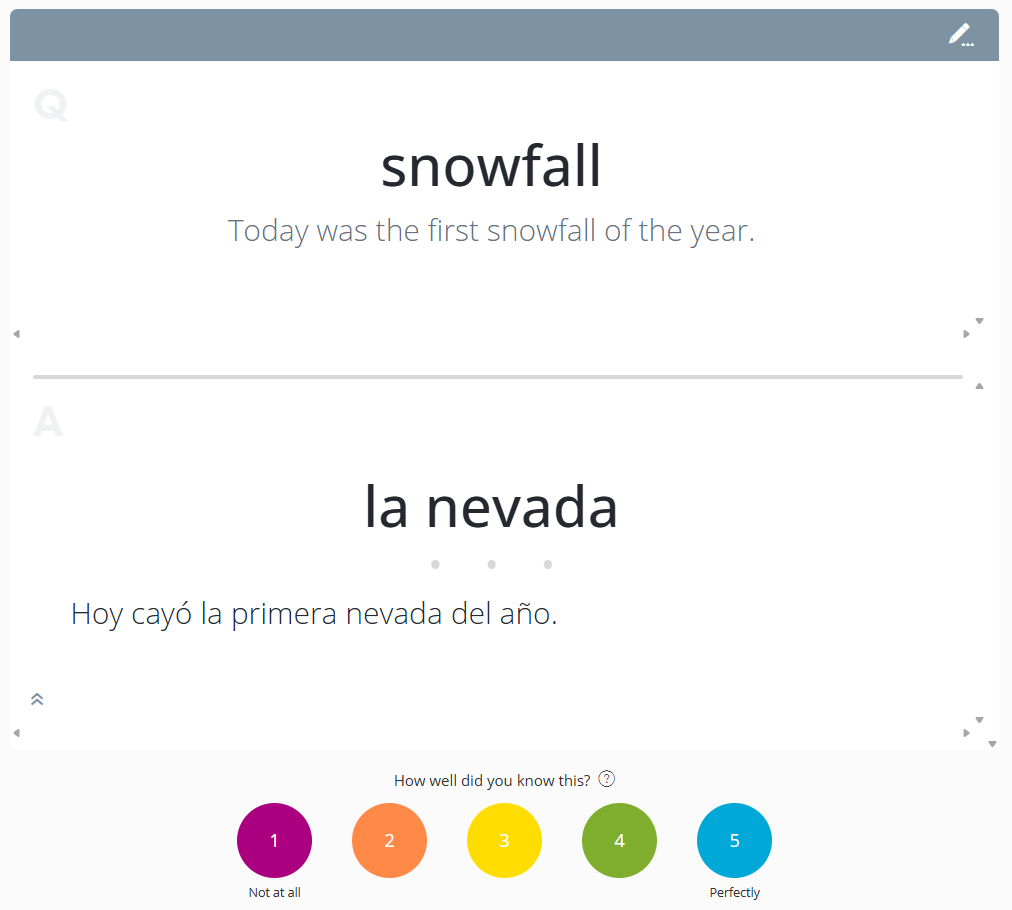
I like to use flashcards where the front is a word and an example sentence in English, and the back is the translation in Spanish. For example, if the front of my flashcard is :
“slipper – I took my shoes off and put on slippers”
I take a few moments to try to remember a) how to say slipper in Spanish and b) construct the sentence with correct grammar, phrasing, and conjugation. Then I flip the card and check my work. I think this card is a good example because the example sentence:
“la pantufla – Me quité los zapatos y me puse pantuflas”
is phrased a little differently than how I would instinctively construct it as a native English speaker.
Paper or digital? Don’t overthink it
I’m the type to take notes with a pen and paper instead of a laptop, so I’ve always felt a little guilty for using digital flashcards instead of making them on paper. In reality, I don’t have anything to worry about. The systematic review that I mentioned earlier discusses how in studies that directly compare the effectiveness of paper flashcards vs. digital flashcards, results show no significant difference.
If you have trouble navigating digital flashcard systems, go for paper. But if you prefer digital flashcards, some studies show they could be more effective, perhaps because they’re easier to study more often on the go, or because it’s easier to add pictures or sound.
Use a flashcard website or application that supports a spaced repetition system (SRS)
This article from Brainscape’s website explains what spaced repetition systems (SRSs) are and some different types. Spaced repetition algorithms repeat difficult concepts more frequently and easier concepts less often. As you learn the material, the space between repeats becomes longer and longer. This way, you focus harder on learning new material, but still review old material after a while to make sure you don’t forget it. Anki is one of the most popular flashcard apps for language learning. Others include Brainscape, Quizlet, and Clozemaster. You can even practice spaced repetition with paper flashcards by separating your cards according to difficulty. All systems and apps are a little different, so I recommend trying some out and choosing what works best for you.
Effective flashcard study techniques
It can be tempting to make your language learning flashcards go by in a flash, but it’s counterproductive to go through your deck too quickly. Take your time to think about each card and quiz yourself instead of flipping straight through them. Say what you think the answer will be in your head or out loud before you flip it over. That way, you’re forced to actually retrieve the material and be honest with yourself about whether you knew the material or not. I often find myself flipping over a card mindlessly, and once I read the definition, I realize that I’m not sure if I knew it or not. That’s when I know I need to take a break and try again when I’m more focused!
Summary
- Flashcards are good for language learning for students of any level.
- Make flashcards for phrases or sentences instead of just words to understand how to use them in context.
- Use flashcards to enforce grammar concepts and verb conjugation.
- Paper or digital flashcards are fine; use what works best for you.
- Try a spaced repetition app to separate your flashcards by difficulty and repeat difficult concepts more frequently and easier concepts less often.
- Use effective flashcard learning techniques and take your time to honestly test yourself and reinforce the material.
References
Lei, Y., & Reynolds, B. L. (2022). Learning English vocabulary from word cards: A research synthesis. Frontiers in psychology, 13, Article 984211. https://doi.org/10.3389/fpsyg.2022.984211
Serfaty, J., & Serrano Serrano, R. (2020). Examining the potential of digital flashcards to facilitate independent grammar learning. System, 94, Article 102342. https://doi.org/10.1016/j.system.2020.102342
Cohen, A. (n.d.) Comparing Spaced Repetition Algorithms. Brainscape. https://www.brainscape.com/academy/comparing-spaced-repetition-algorithms/
Leave a Reply